George had been certain that the home improvements mattered more than his son’s feelings. The dog was taken to the shelter despite the boy’s pleas. But eleven days later, Mary walked into her son’s room and found a drawing that turned everything upside down.
The bags stood by the front door. Two bags, to be exact: in one, the bowls; in the other, the remains of the kibble and a rubber ball that Buster had dragged around the flat ever since he’d learned to walk.
Leo saw them before he’d even taken off his trainers.
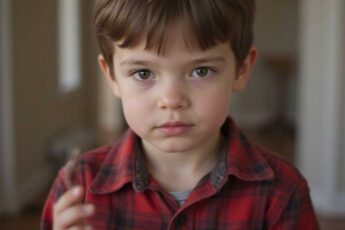
Buster nuzzled the boy’s knee and wagged his tail so hard he knocked against the bag. The bowl inside clinked. His ginger fur smelt of the yard, of autumn leaves, and of something warm, something purely dog-like that always made Leo’s chest tighten. He crouched down, wrapping both arms around the dog. Buster went still, pressed his side against the checked shirt, and rested his muzzle on the boy’s shoulder.
His left hind leg turned awkwardly. The dog had limped on it since puppyhood, and Leo was used to steadying his flank whenever he sat down.
The kettle hummed in the kitchen. Mary stood at the stove, twisting her wedding ring on her finger. Quickly, a habitual movement, as she always did when she wanted to say something but couldn’t find the words. George sat at the table, back straight, hands folded in front of him. A cup of coffee sat exactly in the centre of the saucer.
“Mum. Why are those there?”
Mary didn’t turn. Her fingers on the ring sped up.
“Dad, why are the bags by the door?”
George finished his coffee in one gulp. He set the cup on the saucer so precisely that it didn’t clink.
“Leo, we’ve decided. We’re taking the dog today.”
“Where?”
“To the shelter. Good conditions, I checked. Warm kennels, proper food.”
The boy looked at his mother. She stared out the window where a grey October sky pressed down on the rooftops. The ring kept twisting.
“Mum?”
The kettle clicked off. Silence fell, and they could hear Buster breathing in the hallway.
“Mum, say something.”
Mary straightened the tea towel on the hook. Took it down and hung it again, though it had been straight already.
“Dad’s right, sweetheart. We need to do the renovation. The dog would find it…”
“Buster! His name is Buster!”
“Buster would find it hard. Paint, dust, tools on the floor. It could make him ill.”
She spoke in a flat voice, and every word sounded as if it had been rehearsed the night before while Leo slept.
The boy gripped the edge of the chair. His knuckles went white.
“I’ll walk him three times a day. I’ll keep him in my room. He won’t be in the way. Please.”
George stood up. The chair scraped across the linoleum.
“I’ve said it, so that’s that. We leave in half an hour.”
“Please. Please don’t.”
His voice became thin. Not childish, but transparent, as if the words passed through the boy without stopping. Buster scratched his claws on the tiles, limped into the kitchen, and sat beside Leo, leaning his side against the boy’s leg. He put his muzzle on Leo’s knee.
And stayed still. The dog’s eyes were brown, with flecks of ginger, and they looked up calmly. He didn’t understand. He trusted everyone in this house.
Mary squeezed her eyes shut. For a second, maybe two. Then she opened them and reached into her pocket for the car keys.
Leo pulled on his jacket.
“Leo, you’d better stay home. You don’t need to come.”
“No, I’m coming!” Leo’s voice cracked, close to tears.
In the car it smelt of petrol and warm plastic. The sun never came out, and the town beyond the window seemed drawn in grey pencil on wet paper. Buster lay on the back seat with his muzzle on Leo’s lap. The boy didn’t cry. He sat upright, stroking the ginger head, and his fingers moved slowly, evenly, as if memorising every bump and curl of fur.
Once George looked in the rearview mirror. He looked away quickly.
Mary drove and thought about the wallpaper in the hallway. About the rollers, about the colour “ivory” they’d chosen on Saturday at the builders’ merchant. In a month the flat would be bright. Clean. No fur on the sofa, no clicking of claws in the mornings.
The shelter was on the outskirts, behind the garages. A grey building with an iron door that smelt of bleach, wet concrete, and something sour, thick, that made you want to breathe through your mouth. From the depths came barking. Not loud, not angry. Lonely, as if someone was calling and no longer believed they would be heard.
A woman in a green apron came out to meet them. She smiled at Buster and scratched behind his ear.
“Good boy, ginger. We’ll sort him out, don’t worry.”
Leo held the lead. With both hands, tightly, so the leather strap bit into his palms. His fingers were red from the strain.
“Leo, give it here.”
His father held out his hand. A large palm, smelling of engine oil, opened in front of the boy’s face.
Leo looked at the lead. Then at Buster. Then back at the lead.
And he let go. Slowly.
The woman took the lead and led Buster down the corridor. The dog limped on his left hind, and his claws clicked on the tiles, the sound echoing because the corridor was long and empty. At the turn, Buster looked back.
The woman turned the corner. The clicking grew softer, softer. And disappeared.
On the drive back, the boy sat behind the driver’s seat. Where ten minutes ago Buster had lain. The upholstery still held his scent: warm fur, the yard, autumn leaves. Leo pressed his cheek to the seat and closed his eyes.
Mary reached for the radio. George shook his head. They drove home in silence for twenty minutes. Not a single word.
At home, Leo took off his shoes, walked past the kitchen, and shut himself in his room. The door clicked softly. Simply closed.
Mary put away the empty bags, folded them neatly, and stuffed them into the bin. Then she saw the bowl.
A red plastic bowl with teeth marks around the rim. Buster had gnawed it as a puppy when he didn’t know bowls weren’t for chewing. Mary picked it up and held it. The plastic was light and smooth, and the tooth marks rough under her fingers. She set the bowl back on the floor.
The next day they noticed the changes.
Leo didn’t ask what was for dinner. He didn’t turn on the television. He didn’t take his school diary from his rucksack. He came home from school, took off his shoes, went to his room. Quiet, like a shadow on the wall.
Mary knocked.
“Leo, do you want pasta? With cheese, the way you like it.”
The bed creaked behind the door. Then nothing.
She stood at the door for half a minute. Listened to the silence. And left.
That evening George said: he’ll get used to it. Children forget quickly. In a week he’ll be running around as before. He said this confidently, standing in the hallway where a scratch from Buster’s claws still marked the wall from his first month.
On the fifth day the teacher rang. Her voice was cautious, like someone stepping on thin ice.
“Is everything all right at home?”
“Yes, of course. Why?”
“Leo doesn’t answer in class. At all. He sits and stares out the window. At break he stands alone against the wall. The children approach him, but he stays silent.”
Mary bit her lip.
“We… we gave our dog away. To a shelter. He’ll get used to it.”
The teacher paused. A few seconds, and in that pause Mary heard more than in any words. Then the voice on the line said:
“I see.”
That “I see” hung in the flat all evening. Like the smell of paint that hadn’t been opened yet but was already there.
On the seventh day, Leo stopped coming to dinner. Mary set a plate. She took it back untouched. The pasta grew cold and formed a skin, and that somehow was unbearable.
George bought rollers and primer. He tore off the old wallpaper in the hallway. Beneath it the walls were grey, with patches of old glue, and a crack from floor to ceiling that the sailing-ship picture had once hidden. It smelt of damp. It didn’t become beautiful. And it didn’t become quiet either, because the silence was not the kind he had planned.
The red bowl still sat in the kitchen. Mary couldn’t bring herself to remove it. Three times she picked it up, three times she put it back. On the fourth try she turned it upside down. Then she set it upright again.
One day Mary went into her son’s room while he was at school. She wanted to tidy up.
On the table lay a drawing.
A house with a triangular roof and a chimney with smoke coming out. Ordinary, as all children draw. Next to it a boy: stick legs, a round head, arms out. And beside the boy a ginger blob with four legs and a curly tail. The boy and the dog were drawn brightly, in red felt-tip and orange crayon, pressed hard so the paper was dented.
But the house was empty. Windows without curtains, door wide open. Inside, no figures, no furniture. White.
No mum. No dad. Only white space behind the open door.
Mary sat down on her son’s bed. She picked up the drawing and brought it closer. At the bottom, under the house, in wobbly small letters: “Buster I will come.”
No comma. No full stop. A promise written by a hand that still couldn’t form the letters evenly.
The ring on her finger pressed so hard that Mary took it off. She laid it on the table next to the drawing. And sat there, staring at the wall, because she wasn’t thinking about wallpaper. Not about the colour “ivory.” Not about fur or claws.
She was thinking that her son had drawn a house in which she did not exist.
That evening Mary put the drawing in front of George. She didn’t explain anything. She just placed it on the table, next to his plate.
He looked at it for a long time. Then he pushed his plate aside.
“We’ll get him back.”
Mary blinked.
“Buster. Tomorrow morning.”
And it was he who said it, not she. She had expected to argue, to persuade, to jab a finger at the drawing. But George stared at the empty house without people, and something moved in his face, as if his muscles didn’t know what expression to take.
“Tomorrow. First thing.”
Mary nodded. She wanted to say “thank you,” but the word stuck. There was nothing to be grateful for. It wasn’t a gift. It was an attempt to mend what they themselves had broken.
In the morning they drove to the shelter. The same iron door. The same smell of bleach and wet concrete. The woman came out to meet them, this time in a blue apron, but her face was the same.
Buster recognised them from the doorway. He lunged at the kennel gate, whimpered, wagged his tail so hard his whole body shook. He had lost weight in those days: his ribs showed through the ginger fur, and his left hind turned in worse than before. He limped towards them as fast as he could.
George took the lead. The same leather one, worn. His palm closed around the strap as if it had never left.
At home, Leo was in his room. The door closed.
Claws clicked on the hallway tiles. Softly. Unevenly, with a skip every fourth step.
The bedroom door opened.
The boy stood in the doorway. Buster rushed to him, nuzzled his stomach, licked his hand, his knee, his hand again. His tail thumped against the wall.
Leo sank to the floor. His fingers buried themselves in the ginger fur that smelt of the shelter, of bleach, of strangers. But beneath that scent was another, older, real, the one that always made his chest tighten.
He spoke the first word in days:
“Buster.”
Then he lifted his head. Looked at his mother. At his father.
Mary crouched beside him.
“Leo…”
He didn’t pull away. But he didn’t lean in either. He just sat on the floor, holding the dog, and looked at them as if seeing them for the first time. And he wasn’t sure he recognised them.
Buster licked the boy’s chin and calmed down. He lay down beside Leo, pressing his warm side close.
Mary poured kibble into the red plastic bowl with teeth marks around the rim. Buster limped into the kitchen, claws clicking, and began to eat hungrily, hurriedly. Leo sat beside him.
And George stood in the hallway where the stripped walls smelt of damp and old glue. The roller lay in the corner, covered in dust. The primer had dried in the can. The crack from floor to ceiling had not gone away.
From the kitchen came the sound of the bowl scraping against the floor and the dog’s eager chewing.
George stood and looked at the walls. The renovation had not moved forward. And now it didn’t matter whether it did. Because in this house, something else needed fixing.