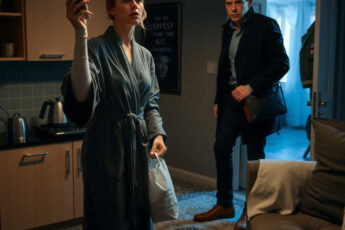
Martha darts behind the pantry door a second before the lock clicks. She presses her back against a shelf of tins, feels the inner handle and pulls just enough to leave a fingerwide gap. She breathes hard, wheezing, and clamps her mouth with her palm because the hallway is dead silent and any sound would echo through the flat.
The front door swings open.
David coughs and steps into the hall. Through the narrow slit Martha sees his hands: two white grocery bags, tightly packed, ropewrapped handles digging into his fingers.
Mum! he calls. Are you home?
Martha presses her palm tighter.
***
Martha has been living alone for five years. David died suddenly, as it often happens with people who keep their pain hidden his heart gave out and that was that.
The first year without him is the hardest: not the grief itself she can endure that but the silence in the flat drives her to the edge. David used to laugh at the television so loudly that every word could be heard in the kitchen. He sang profanely in the bathroom, mangling lyrics and melody without a hint of shame. Now, with the bathroom door shut, the only sound is the hum of the pipe, and that hum feels deafening.
Her daughter Poppy arrives from Manchester in the first few days. She stays for two weeks, cleaning, cooking, and at night sitting on Marthas bed, simply being there, never demanding conversation. It is a priceless comfort.
Jack never turns up, neither then nor later. He has been gone for eleven years, and Martha has stopped explaining out loud why, though inside she replays the story over and over like a worn record.
Jacks departure is painful and tangled, the truth having been tucked away under the rug for far too long. He has been difficult since childhood: sharptempered, quick to flare, throwing tantrums at any slight. School barely holds him together; he repeats a year in sixth form and graduates with a string of Cs. His sister Helen is the opposite: calm, exemplary, always bringing home As.
Jack is angry at Helen, snaps at remarks, and David sometimes loses his temper, though he tries to hold back.
When Jack turns nineteen, David sends him for the summer to his mother, old Agnes, in a village near York, thinking the country air and hard work will ground him away from city idleness.
Agnes is blunt to a fault, never keeping her tongue behind her teeth, and when Jack messes up the garden she hurls at him, What did you expect, you drudge?
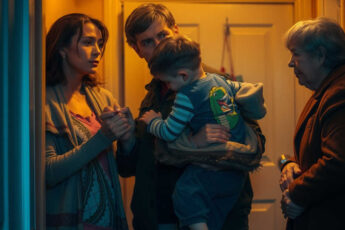
Jack returns to London the same day. He drops his bag in the hall, walks to the kitchen, sits and asks quietly, almost without intonation, Is it true?
Martha looks at David. David looks at her.
They have been planning to tell Jack themselves when the right moment arrives, but they keep postponing, convincing each other its too early, that he needs to grow a little more.
Its true, Martha says. We took you from the orphanage when you were eight months old. You cried terribly, filled the whole ward with screams, but when you saw us you fell silent and stared at me.
She turns to David: Our son, nowhere else to go.
Jack stands and goes to his room. Martha and David sit in the kitchen until midnight, talking about anything except this, because they dont know how to speak about it.
A few days later Jack disappears, taking the money Martha and David had saved for his dorm room a surprise they had planned for autumn. He makes his own surprise first.
David rarely mentions him out loud. In the evenings he sits by the window, watching the street.
Martha sees his pain but doesnt pry; David copes with silence, and she respects that. A few years later his heart stops.
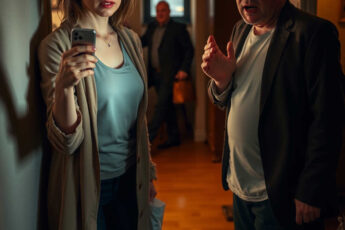
Jack reappears at the start of April. He knocks gently, not ringing, as if unsure anyone will answer.
Martha opens the door and stands for a few seconds, staring at him: a thirtyyearold man with a noticeable stubble, slightly hunched, holding a bag of oranges.
Mum, he says. Im sorry. I acted foolishly.
She stands, not knowing what to do.
I want to make up, he adds. If youll give me a chance.
She embraces him at the threshold. He hugs back awkwardly, stumbling, like someone who has spent years without affection and forgotten how it feels.
At dinner he talks about working as a chef across the country, from Bristol to Newcastle, starting in cheap diners and climbing to restaurants. He really does cook well.
Martha watches him carving a chicken with deft hands, thinking life is odd: a man vanishes for eleven years and then returns to fry you cutlets.
He stays, takes his old room, spreads his belongings on the shelves, and in the mornings makes porridge or eggs.
Martha calls Poppy each evening.
Hes back, Poppy says. Hows he holding up?
Fine. Polite. Good cooking.
Mum, are you sure everythings okay? Eleven years is a long time.
Poppy, hes my son. Dont act like a stranger.
She phones relatives across the country, telling everyone: Jacks back, Jacks home. A cousin from Sheffield sighs on the line, saying theres no smoke without fire and people dont just pop back from nowhere.
Martha answers that theres no need for drama; everythings fine.
About two weeks later she notices shes tiring far more than before. By evening her head feels padded with cotton, and in the mornings shes dizzy.
She tells herself its spring: a vitamin deficiency, bloodpressure swings, age. At sixty health is unreliable, nothing specific to complain about. The main thing is: her son is nearby.
Poppy asks about her health in the evenings. Martha says shes fine, a bit weary, but it will pass.
Maybe see a doctor? Poppy suggests.
Come off it, Im not sprinting to clinics for every fatigue. Appointments take weeks, itll pass.
It doesnt. Nausea builds, her head grows heavy by noon.
She drinks vitamins, brews rosehip tea, and tries not to obsess.
That night she wakes early, before six. Grey April sky watches her from outside, the street empty.
Her mouth is parched; she swallows hard, slips on slippers,She steps onto the train, the carriage lights blinking, and resolves that whatever comes next, she will finally let go of the past.