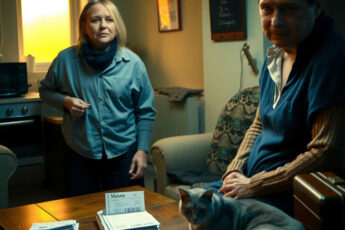
Im George Whitaker, 52, and I thought Id finally nailed the perfect relationship formula when I met Blythe Hartley eight years ago. She was 46, lovely, and, in my mind, the sort of woman who would happily slide into the traditional role of the supportive partner while I remained the households chief strategist. Id already collected a résumé of a marriage, a divorce, a few career missteps and the occasional epiphany, so I felt confident I knew exactly how to keep the peace.
We lived together in my flat in Manchester, a cosy twobedroom that I liked to remind Blythe of as my place, your place, our place in the most offhand way possible. It worked at least until I conjured up what I thought was a brilliant, modern idea: a completely separate budget.
I presented it as a noble, transparent solution. Everyone pays for what they spend, I said, trying to sound like a forwardthinking gentleman. No more squabbling over who contributed what, no hidden resentments. Just two adults, two wallets. Blythe, with the startling speed of someone who had already decided everything in her head, nodded and replied, Alright, lets give it a go.
That should have set off my alarm bell, but I chalked it up to her being unusually agreeable and moved on. After all, a woman who says yes without a fuss is either meek or already on board with the plan and I was desperate for validation.
The first few months were pictureperfect. We split the grocery bill, the council tax, the internet, and everything else. Each of us paid our own share, and I felt a warm glow of fairness spreading through the flat. No more lingering suspicion that I was secretly paying more than my fair share a feeling that had nagged at me even though I tried to play the generous, stoic gentleman.
But then, as the old saying goes, the devil is in the details, and the detail in this case turned out to be freedom.
Six months in, Blythe started to change not outwardly, she still cooked, cleaned, and kept the house tidy, but there was a new lightness to her. She moved with a quiet confidence that I hadnt seen before. She stopped asking my opinion on little things, stopped checking in before buying something, and started picking up new bags, shoes and other trinkets that seemed, to my frugal eyes, outright unnecessary.
We had agreed to save together for a summer holiday, a twoweek seaside break in Cornwall. I assumed Blythe was contributing the same way I was, but my own finances were a bit of a leaky bucket. Id lent a mate a few hundred pounds, paid off a lingering creditcard balance, and even bought a new set of tools for the garage all reasonable, I told myself. The sum Id earmarked for the holiday never quite materialised, but I was convinced it would sort itself out because, after all, were a team.
One evening Blythe walked in, a smile plastered on her face, and said, Ive booked the tickets.
Tickets for what? I asked, heart suddenly doing the sort of flip you reserve for rollercoasters.
For a fourweek holiday on the Costa del Sol, with my friend Claire.
My jaw hit the floor. With a friend? What about us?
She shrugged, as if Id just asked why the sun rises. You said it was a waste of money anyway.
And there it was the exact line Id used a few months earlier to dismiss the idea of an extravagant getaway. The irony was not lost on me. I remembered telling her, We could just go camping in the Lake District; we dont need to fly to Spain. Shed heard me, taken notes, and then booked a blissful escape without so much as a courtesy headsup.
Couldnt you have at least asked? I demanded, feeling my face turn the colour of a ripe tomato.
Its my money, she replied, deadpan. You were the one who suggested we split everything.
In that moment I realised Id walked straight into a trap of my own design. My version of a separate budget had an unspoken clause: I decided where the money went; Blythe simply followed the script. In reality, shed taken the script literally, becoming an equal partner and that equalisation meant she now owned the right to make decisions, not just the duty to pay her share.
I tried to argue that relationships werent supposed to work like a spreadsheet, that decisions should be joint, that I deserved to be consulted before she whisked herself off to a sunkissed beach while I was left alone with Milly the cat, a dampeyed tabby who now stared at me as if Id betrayed the entire species.
She looked at me, calm and unapologetic. You set the rule, George. Im just playing by it.
That was the moment the whole system Id built collapsed. Equality, I discovered, isnt just about sharing chores or splitting the rent it also hands over the right to choose. And I wasnt prepared for that.
She left, my flat suddenly felt hollow, and for the first time in years I was not the master of my domain. Blythe sent occasional postcards, sunsplashed selfies, and cheerful updates about beachside cafés. Each message contained the one thing that grated most: she wasnt missing me. She didnt apologise, didnt beg to come back, didnt even feel guilty.
I tried to convince myself the problem lay with her that shed gone rogue, that shed got too much freedom. It was easier than admitting that Id wanted a convenient version of independence, a woman who could be selfsufficient only so long as she didnt use that independence to step out of my shadow.
When she finally returned after a month, tanned and relaxed, I felt like we were sharing a flat that no longer belonged to either of us. We still live together now, but the budget conversation is dead, and an invisible line runs between us a boundary made of unspoken expectations and a fresh awareness of what true equality looks like.
The real punchline? It wasnt about the pounds or the Costa del Sol. It was about seeing equality in action and feeling, for the first time, that Id lost the control I never really wanted to relinquish.
**Psychologists take**
This tale is a textbook case of the clash between declared egalitarianism and an underlying need for control. George proposes a separate budget as a fairplay gesture, yet his subconscious expectation is that the hierarchy stays intact: his opinions dominate, Blythe remains a participant, not an autonomous decisionmaker.
When Blythe interprets the rule literally and begins exercising genuine independence, George experiences cognitive dissonance the outward appearance of equality collides with an internal sense of power loss. The result is irritation, blameshifting, and an attempt to reestablish the old order through passiveaggressive remarks.
The lesson here is simple: you cant split finances without also sharing decisionmaking authority. True financial independence inevitably brings broader autonomy, and if one partner isnt ready to accept that, the fair arrangement will feel anything but fair. Recognising and adjusting ones own expectations is the only way to move from a fragile, scripted partnership to a genuinely balanced relationship.