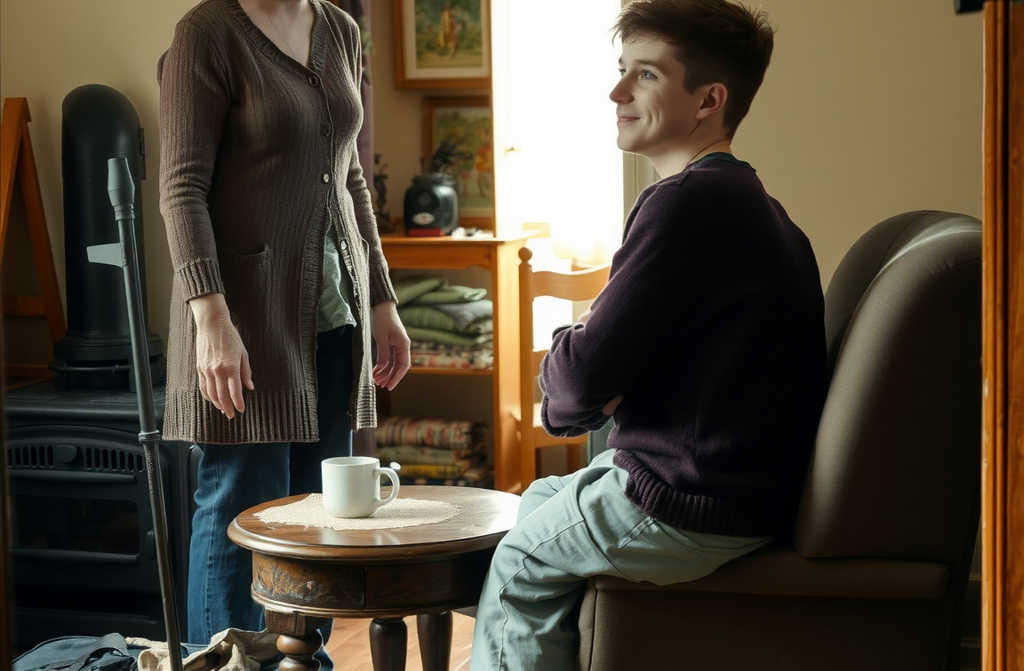
Christopher, are you out of your mind? You think Im inviting you to live with me because Ive got a few pounds to spare? I feel sorry for you, thats all.
I remember the day I sat in my wheelchair, watching the world through grimy panes that looked out onto the inner courtyard of St.Marys Hospital. The courtyard was a tidy little square, dotted with market stalls and flowerbeds, but it was almost deserted. It was winter, and the patients rarely ventured outside for a breath of fresh air. I was alone in my ward.
A week earlier my neighbour, Oliver Turner, had been discharged and gone home. Oliver was a jovial fellow, a thirdyear drama student who could spin a hundred tales and perform them with the flair of a seasoned actor. His mother visited daily, bringing warm scones, fresh fruit and sugary treats, which Oliver would generously share with me. With his departure the small homeliness that had held the ward together vanished, and I felt a loneliness I had never known before.
My gloom was interrupted when a nurse entered. My spirits sank even further: the brighteyed Emma I had hoped for was replaced by the perpetually sour MrsMargaret Thompson, a middleaged woman who seemed forever displeased. In the two months I had spent in the hospital I had never seen her smile; her voice was as sharp and gruff as the lines etched on her face.
Why are you staring? Back to bed! she barked, brandishing a syringe already filled with medication. I sighed, turned my chair toward the bed, and she helped me lie down, then, with a swift motion, rolled me onto my stomach.
Strip off your trousers, she ordered. I obeyed, feeling nothing as the needle slipped into the faint vein in my gaunt arm. I thanked her silently for the skill with which she administered the injection.
I wondered how old she might be. Probably a pensioner by now, with a tiny pension that forces her to keep working, I thought, trying to make sense of her harshness.
She finished the injection and asked, Did the doctor come today?
No, I shook my head. Maybe later
Dont sit by the window, she warned, its draughty and as dry as a biscuit. She left the ward, and though I wanted to take offense, there was a thread of concern in her coarse words that I could not dismiss.
I was an orphan. My parents perished in a fire when I was four, the blaze consuming the farmhouse where I had lived. My mother, with the last of her strength, threw me out a shattered window onto a pile of hay, saving my life just moments before the roof collapsed, burying the rest of the family. I was taken to an orphanage; relatives existed but never opened their doors.
From my mother I inherited a gentle, dreamy disposition and bright green eyes; from my father I got height, a lanky gait, and a knack for numbers. My memories of them were fleeting, like fragments of an old film: a village fête where I waved a flag with Mother, sitting on Fathers shoulders feeling the summer breeze on my cheeks. I also remembered a large ginger cat I once called Marmalade, though no photographs survived the fire.
No one visited me in the hospital. When I turned eighteen, the state assigned me a bright room on the fourth floor of a municipal dormitory. I liked the solitude, though at times a deep ache would swell and bring tears. I grew accustomed to being alone and even began to see its advantages.
The orphanage years still haunted me. Watching children with parents on playgrounds, in shops, or simply walking the streets of London filled me with a bitter sting. After school I dreamed of university, but my exam scores fell short, so I entered a technical college. I liked the course, but I never fitted in with my classmates. Quiet and withdrawn, I found little interest in their chatter; I would rather lose myself in books and scientific journals than in noisy parties or video games. When we did speak it was only about coursework. As for girls, my modesty was not deemed a masculine trait, and the more outspoken lads always attracted their attention.
At eighteen and a half I still looked no older than sixteen, earning me the nickname the white raven among my peersa moniker that never quite bothered me.
Two months before my discharge, in a rush to get to class, I slipped on an icy pavement, fell in the underground passage and shattered both legs. The fractures were complex and healed slowly, though the past few weeks had brought improvement. I hoped to leave the hospital soon, but anxiety gnawed at me: the flat I lived in had no lift or ramps, and I would be confined to a wheelchair for a long while yet.
After lunch DrRobert Abbott, the orthopaedic surgeon, entered. He examined my legs, studied the Xrays and said, Well, Christopher, good news: the bones are finally knitting as they should. In a few weeks you should be on crutches. Theres no point keeping you here; youll be discharged to outpatient care. Theyll bring your paperwork in about an hour. Will anyone meet you?
I nodded silently.
Excellent. Ill summon Margaret; shell help you pack. Stay healthy, and try not to end up back here.
Later, Margaret broke my reverie. Why are you still sitting? Theyre sending you home, she said, handing me a backpack that had been tucked under the bed. Pack up, dear. Nurse Nina will change the linens. She gave me a lingering look.
Why did you lie to the doctor? she asked, tilting her head.
What do you mean? I replied, bewildered.
Dont play the fool, Chris. I know no one will come for you. How will you get home?
Ill manage somehow, I muttered.
You wont be able to walk for at least half a month. How do you intend to live?
Im not a child, I snapped.
She sat down beside me, her eyes softening. Christopher, it may not be my business, but with those injuries youll need help. You cant do it alone. Im not trying to be cruel, Im just being honest.
Ill manage on my own, I insisted.
She sighed, Ive been in nursing for years. You think you can argue like a child? Look, I live out in the country, a couple of steps up a porch, a spare room ready for you. When youre on your feet again youll go home. I live alone; my husband died long ago and I have no children.
My mind went blank. I had no family left, no one else to turn to.
Whats the matter? she asked, frowning.
Its… uncomfortable, I stammered.
Stop the bravado, Chris. Its uncomfortable to live in a wheelchair in a house without a lift or a ramp. So what will it bewill you come to my place?
I hesitated. The thought of staying with a stranger was uneasy, yet she seemed less alien than any other. I recalled the small kindnesses shed shown: Close the window, its cold, Eat the cheese, it has calcium, Dont forget your meds. She was, in the end, the only one willing to reach out.
Ill stay, I said finally, but I have no money; my stipend wont arrive for a while.
Margarets face hardened. Christopher, are you out of your mind? You think Im offering you a roof because Im rich? I feel sorry for you, thats all.
I tried to apologize, but she waved it off. Im not offended. Lets get you to the ward; youll sit there until my shift ends, then well go.
Her cottage was a modest, tidy house with narrow windows. Inside were two snug rooms; one was set up for me. In the first days I was ashamed, hardly leaving the room, careful not to burden my new host with requests.
She called me out plainly, Stop being shy. Ask for what you need; youre not a guest.
I grew to love the place: snow drifts against the window, the cheerful crackle of the fire, the scent of homecooked stewall reminders of the home I had lost.
Days passed. My wheelchair was replaced by crutches. The time came to return to the city. After another visit to the clinic, Margaret walked beside me, we trading plans.
I need to sit my exams, catch up on credits. Ive lost so much time, its a nightmare. I dont want to go back to the technical college, I confessed.
Take what you need, she replied, your college wont disappear. Start moving now, as the doctor advised, and reduce the load on your legs.
In the weeks that followed we grew close. I often caught myself not wanting to leave the cosy cottage or the woman who had become, in many ways, a second mother. Yet I could not summon the courage to admit it, even to myself.
The next morning, while gathering my things, I searched for a phone charger. At the doorway stood Margaret, tears streaming down her cheeks. I crossed the room and embraced her.
Perhaps youll stay, Christopher? she whispered through sobs, How shall I live without you?
I stayed. Years later she sat at my wedding, honoured as the motherfigure of the groom, and a year after that she cradled my newborn granddaughter, whom we named after herLydia.
Now, when I look back on those long, cold winter days in St.Marys and the kindness of a stern nurse who turned into a guardian, I understand that sometimes the harshest voices hide the deepest compassion. The world may have taken everything else, but it gave me a home when I needed one most.